DTE Energy
Investor-OwnedService Area: Southeast Michigan & Thumb region
Customers: 2,300,000
Current Capacity: ~11 GW
Data Center Pipeline: ~7 GW requested
Key Projects:
- Oracle/OpenAI Stargate (1.4 GW)
Ground zero for America's AI infrastructure debate
Michigan has emerged as a major battleground for data center development, with 11+ large-scale projects proposed since 2024. The state's combination of available land, grid infrastructure, and new tax incentives has attracted billions in proposed investment—and significant community opposition.
View Michigan Policy Profile →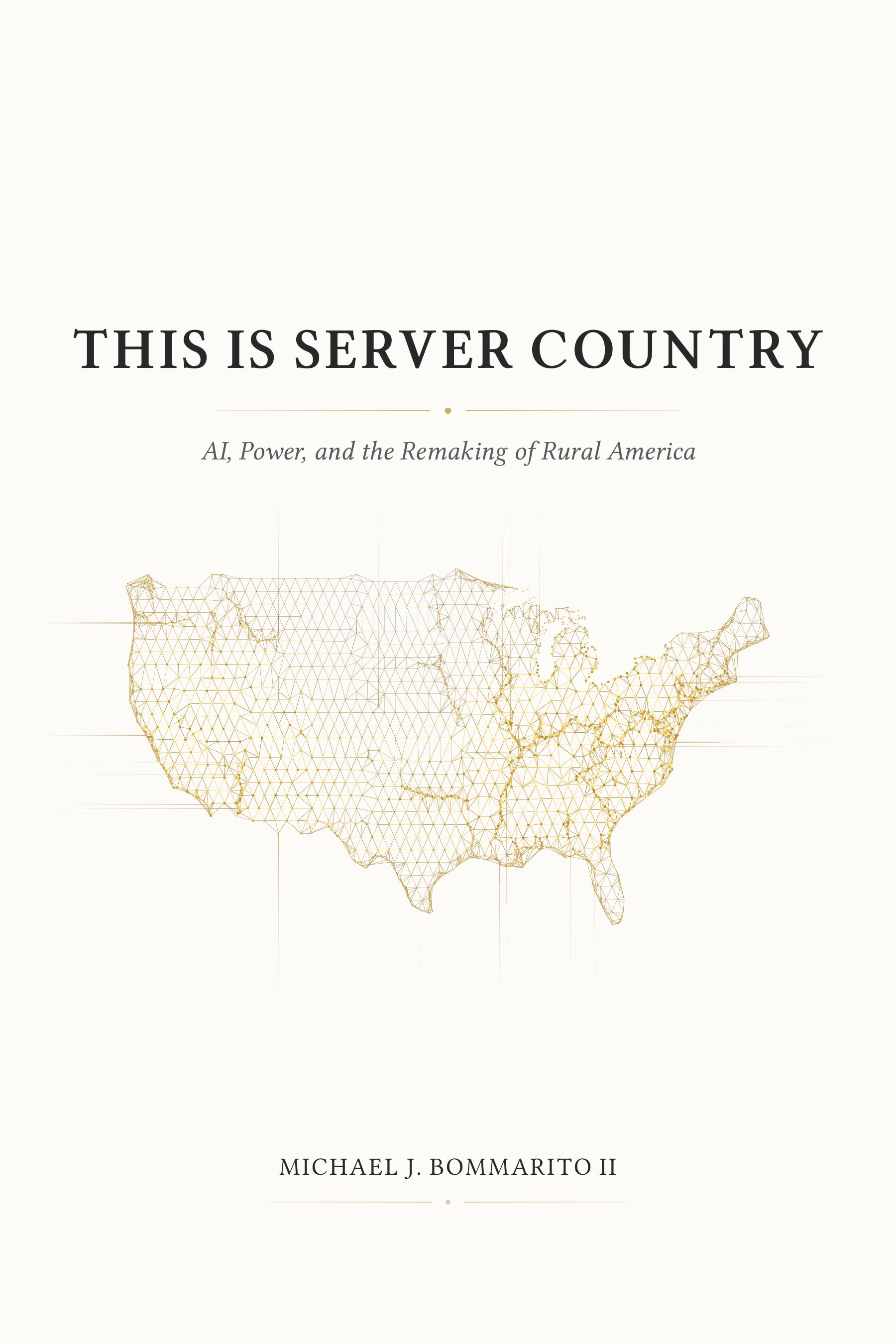
Featured in Chapter 9 of
This Is Server CountryMichigan's entry into data center incentives and the Saline Township story are detailed in "The Incentives" chapter.
To understand data center debates, you need to understand how electricity gets to your home. The U.S. power grid operates in layers, from federal oversight down to your local utility. Here's how it works in Michigan:
Federal Energy Regulatory Commission
Oversees interstate transmission of electricity, natural gas, and oil. Sets wholesale electricity market rules. Approves transmission rates and major infrastructure projects that cross state lines.
Midcontinent Independent System Operator
Operates the regional grid across 15 states including most of Michigan. Manages wholesale electricity markets, balances supply and demand in real-time, and coordinates the interconnection queue for new generation and large loads like data centers.
Note: Southwest Michigan (St. Joseph, Cass, and Berrien counties served by Indiana Michigan Power) operates within PJM Interconnection, not MISO.
Michigan Public Service Commission
Regulates Michigan's investor-owned utilities, sets retail electricity rates, approves utility contracts, and protects consumers. For data centers, the MPSC has become the key decision-maker on major power supply agreements.
IOUs, Municipals, and Cooperatives
The companies that actually deliver electricity to your home or business. Michigan has investor-owned utilities (like DTE and Consumers Energy), municipal utilities (owned by cities), and rural electric cooperatives. Each type operates under different regulatory frameworks.
When a data center proposes to use 500 MW of power (enough for 400,000 homes), it must navigate all these levels. The regional grid operator (MISO) must confirm there's enough capacity. The state regulator (MPSC) must approve contracts that protect other ratepayers. And the utility must actually build or procure the generation.
Regional grid operators don't work in isolation. MISO connects to PJM (to the east), SPP (to the southwest), and other regions through transmission "seams." The Eastern Interconnection links grids from the Rockies to the Atlantic coast—only Texas (ERCOT) operates largely independently.
This means a heat wave in the Southeast, a coal plant retirement in Indiana, or a new data center cluster in Ohio can all affect electricity prices, reliability, and available capacity in Michigan. When grid planners assess whether Michigan can support new data center load, they must consider demand growth across the entire interconnected system.
MISO coordinates the reliable delivery of electricity across a region spanning from Michigan to Montana, manages wholesale electricity markets, and oversees the interconnection queue for new generation and large loads.
Southwest Michigan (St. Joseph, Cass, and Berrien counties) is served by Indiana Michigan Power, which operates in the PJM Interconnection rather than MISO.
State agencies play a critical role in data center development. The MPSC regulates utilities and approves contracts, while other agencies handle environmental permits, economic incentives, and more.
The MPSC regulates Michigan's investor-owned electric and natural gas utilities, setting rates and approving service contracts. For data centers, the MPSC has become the key decision-maker on utility contracts and ratepayer protections.
Michigan Department of Environment, Great Lakes, and Energy
Environmental permits and compliance
www.michigan.govegle →Michigan Economic Development Corporation
Economic development and tax incentives
www.michiganbusiness.org →Michigan's electricity comes from three types of utilities: investor-owned utilities (IOUs) that serve most of the state's population, municipal utilities owned by cities and villages, and rural electric cooperatives. Each type operates under different regulations and governance structures.
Regulated by the MPSC. These for-profit companies serve 4,292,000+ customers across Michigan.
Service Area: Southeast Michigan & Thumb region
Customers: 2,300,000
Current Capacity: ~11 GW
Data Center Pipeline: ~7 GW requested
Key Projects:
Service Area: Lower Peninsula (outside Detroit)
Customers: 1,800,000
Data Center Pipeline: 15 GW potential demand
Key Policies:
Coal-Free Target: 2025
A subsidiary of Axium Infrastructure
Service Area: Upper Peninsula
Customers: 52,000
A subsidiary of American Electric Power (AEP)
Service Area: Southwest Michigan (St. Joseph, Cass, Berrien counties)
Customers: 140,000
Grid Operator: PJM Interconnection (not MISO)
Transmission utilities move high-voltage electricity across long distances. They don't serve retail customers directly but are essential infrastructure for data center growth.
A subsidiary of ITC Holdings (Fortis Inc.)
Service Area: Statewide transmission network
Network: 9,100+ circuit miles of high-voltage transmission
Key Projects:
Michigan has 40+ municipal electric utilities, locally owned and operated by cities and villages. These utilities are not regulated by the MPSC and make their own decisions about data center service.
Largest municipal utility in Michigan. Partner on Deep Green DG06 data center project, providing waste heat to downtown district heating.
Data Center: Deep Green DG06 (24 MW)
www.lbwl.com →Second-largest municipal utility. Serves Holland area in Ottawa County with strong industrial base.
Municipal utility serving Grand Haven with wind and gas generation resources.
Upper Peninsula municipal utility with hydroelectric generation.
Municipal utility in northern Lower Peninsula serving Traverse City area.
Municipal utility serving Bay City in the Saginaw Bay region.
Michigan has 10 distribution cooperatives serving rural areas, plus one generation and transmission cooperative. These member-owned utilities are not MPSC-regulated and collectively serve about 500,000 Michigan residents.
Generation and transmission cooperative that provides wholesale power to five distribution cooperatives. Wolverine has secured federal funding to purchase nuclear power from the reopened Palisades Nuclear Plant.
Largest electric cooperative in Michigan and second-largest in U.S. by miles of line.
Serves northwest Lower Peninsula including Grand Traverse area.
Serves southwest Michigan and parts of northern Indiana.
Serves mid-Michigan including Clinton, Gratiot, and Montcalm counties.
Serves Michigan's Thumb region (Huron, Sanilac, Tuscola counties).
Serves northeast Lower Peninsula including Alpena, Presque Isle, Montmorency.
Michigan's electricity generation remains heavily dependent on fossil fuels, though the state has set ambitious clean energy targets. The gap between current generation and future targets is a key tension point for data center development.
Source: EIA, Low Carbon Power (2024-2025)
Based on Public Acts 229, 231, 233, 234, 235 of 2023
Michigan's 2023 clean energy laws include an "offramp" provision allowing utilities to continue fossil fuel generation if renewable sources cannot handle grid load. Critics argue that adding 7+ GW of data center demand could trigger this offramp, effectively derailing the state's climate goals. The MPSC has stated clean energy compliance will be addressed in separate proceedings.
Michigan has enacted significant legislation affecting data center development, from tax incentives to clean energy requirements. Understanding these policies is essential for following the debate.
Senate Bill 237 / House Bill 4906 | Signed 2024-12-30
Senate Bill 237 (Public Act 181 of 2024), signed December 30, 2024, exempts qualifying data centers from sales and use tax on equipment purchases through December 31, 2050 (extended to 2065 for brownfield sites). A companion bill, House Bill 4906 (Public Act 207 of 2024), amended the General Sales Tax Act.
SB 237's passage and implications are examined in detail in Chapter 9: The Incentives.
Public Act 235 of 2023, Public Act 229 of 2023, Public Act 231 of 2023, Public Act 233 of 2023, Public Act 234 of 2023 | Signed 2023-11
Public Act 235 of 2023 (part of the Clean Energy Future package) and related acts 229, 231, 233, and 234, signed by Governor Whitmer in November 2023.
Critics argue that adding 7+ GW of data center demand could trigger the offramp provision, allowing utilities to continue fossil fuel generation and effectively derailing Michigan's climate goals. The clean energy requirements in SB 237's tax exemption may be met through REC purchases rather than physical renewable generation.
First-in-state data center tariff establishing rules for customers with 100+ MW minimum service threshold. Includes 15-year minimum contract term, ratepayer protection provisions, and prohibitions on cost-shifting.
MPSC conditionally approved 19-year, 1.4 GW power supply agreement for Saline Township (Oracle/OpenAI Stargate) with mandatory ratepayer protections. AG Dana Nessel filed petition for rehearing in January 2026.
Three bills introduced by Democratic senators to regulate data center environmental impacts.
Bipartisan bill introduced by Rep. Dylan Wegela (D) and Rep. Jim DeSana (R) to repeal data center tax incentives enacted in late 2024.
Michigan has 16 documented data center projects in various stages of development. Here are the major active projects:
Saline Township • Washtenaw County
Part of OpenAI's Stargate initiative. The 575-acre, approximately 2.2M-square-foot campus is under construction. MPSC conditionally approved DTE's 1,383 MW contracts with ratepayer protections. The $16B financing announcement, $43.098B IFEC filing, and $4.811B settlement exhibit are different figures.
Howell Township • Livingston County
Hyperscale campus backed by Meta Platforms at Grand River Avenue and Fleming Road. Planning Commission voted unanimously to recommend denial after a 7-hour hearing. Township adopted a 6-month moratorium November 2025. Developers Stantec and Randee LLC formally withdrew the rezoning application on December 8, 2025, citing respect for the moratorium.
Gaines Township • Kent County
Microsoft has assembled 356 acres along Patterson Avenue between 68th and 76th streets (purchased from Steelcase), less than 5 miles from Switch's campus. On April 15, 2026, the Planning Commission voted 7-0 to table Microsoft's rezoning request after a 5.5-hour hearing with 67 public comments and nearly 600 attendees.
Van Buren Township • Wayne County
Hyperscale campus on 282 acres north of I-94 between Haggerty Road and I-275, advanced by Panattoni. Planning commission cleared the preliminary site plan in February 2026 and the board approved 5-2 in March despite community opposition. Google confirmed involvement March 17, 2026 and committed to finance 2.7 GW of new solar and storage through DTE. Largest data center in Michigan by power draw if built as planned.
Lowell Township • Kent County
235-acre campus at 4687 Alden Nash Ave SE in Covenant Business Park near I-96, tied to Microsoft after Franklin Partners paused its rezoning application and Microsoft was later revealed as the end user. Part of Microsoft's ~900-acre West Michigan assembly outside Grand Rapids.
Dorr Township • Allegan County
272 acres off 144th Avenue near US 131, about 20 miles from the Gaines Township site, purchased by Microsoft in 2024 for more than $48 million. Preliminary stage with no site plan filed; protests have been held over farmland conversion concerns.
City of Southfield • Oakland County
Two-story, ~218,000 sq ft, 100 MW data center on ~12 acres of vacant land near Inkster Road between 11 Mile and I-696. Southfield City Council approved the site plan 5-2 in December 2025. Uses closed-loop cooling for minimal water use. Expected to create ~35 permanent jobs plus 150–200 construction jobs.
Lyon Township • Oakland County
Six-building hyperscale campus with 1.8 million sq ft on the east side of Milford Road south of the Huron Valley Trail. Developed by Verrus, a Sidewalk Infrastructure Partners (Alphabet-backed) company, on land owned by Walbridge. Conditionally approved by the planning commission in September 2025; energy audit and sound study still under review as residents push for a moratorium.
Frenchtown Township • Monroe County
Cloverleaf Infrastructure plans a roughly 200-acre campus on a former golf course near I-75 and North Dixie Highway, with four data center buildings envisioned. Part of Cloverleaf's Monroe Campus strategy (backed by $300M raise). Informational meetings have drawn significant community pushback; no construction timeline announced.
Dundee Township • Monroe County
350-acre site in Dundee Township explored by Cloverleaf Infrastructure as part of its Monroe Campus. Township officials approved a temporary moratorium on data center applications amid local opposition, halting the project.
City of Mason • Ingham County
No developer publicly named, but a Bloomfield Hills attorney notified Mason in February 2026 that a client is evaluating sites for a hyperscale data center in or near the city. Mason enacted a moratorium January 6, 2026, lifted it February 3 after adopting an M-3 zoning district, then repealed the ordinance to draft stricter rules. Recall effort launched against Mayor Russell Whipple and Councilwoman Elaine Ferris over the votes.
Gaines Township • Kent County
Largest data center campus in eastern U.S. Located at former Steelcase pyramid campus. Over 1M sq ft built out with continuous expansion planned for 10+ years. Part of $5B financing plan.
Ypsilanti Township • Washtenaw County
High-performance computational research center on Textile Road. U-M confirmed purchase of a 124-acre parcel in March 2026, adjacent to a previously acquired 20-acre parcel — bringing the site to ~144 acres. Los Alamos has confirmed its portion will support nuclear weapons stockpile research, including plutonium pit simulations. Ypsilanti Township board adopted a formal resolution of opposition on March 31, 2026.
Augusta Township • Washtenaw County
Township Board approved rezoning in July 2025, but residents collected 957 signatures to trigger a 2026 ballot referendum. Project would use 1M gallons of water per day.
Dowagiac • Cass County
Converting former manufacturing facility from Bitcoin mining to AI/HPC infrastructure. Currently 30 MW, expanding to 70 MW by 2027, full 340 MW by 2029. Partnership with NVIDIA for Blackwell AI infrastructure.
Lansing • Ingham County
Deep Green's first U.S. facility. Ultra-efficient design (PUE <1.17) with waste heat recycled into Lansing's district heating network, supplying up to 25% of downtown heating demand.
Major transmission upgrades are underway in Michigan as part of MISO's Long Range Transmission Plan (LRTP). These projects will significantly expand the state's capacity to deliver power—critical infrastructure for proposed data center growth.
Part of MISO's largest-ever transmission portfolio approved in December 2024. Regional costs are shared across multiple states in the MISO footprint.
~50 miles of 345kV line from Oneida Substation (Eaton County) to new Sabine Lake Substation (Livingston County). Estimated cost: $272M + $255M upgrades + $73M for three new substations.
Status: Routing study phase. Community listening sessions ongoing.
~40 miles of new 345kV line from Oneida Substation (Grand Ledge) to Nelson Road Substation (Carson City) through Ionia, Eaton, Clinton, and Gratiot counties.
Counties: Ionia, Eaton, Clinton, Gratiot
~55 miles of new 345kV line from northern Indiana border through Branch and Calhoun counties to new Helix Substation. First new interstate connection to Michigan's transmission system in nearly 50 years.
Counties: Branch, Calhoun
Our comprehensive database tracks 31 data center projects in Michigan, including detailed information on sponsors, power capacity, investment amounts, and current status.
View Michigan Data →The book tells the full story of Michigan's data center boom, including detailed coverage of SB 237, the Saline Township controversy, and DTE/Consumers Energy policy decisions.
Get the BookConsumer advocacy for utility customers
Environmental journalism covering data center impacts
Clean energy and environmental advocacy
Environmental law organization active in MI tariff cases
Clean energy policy and data center guidelines analysis
State politics and policy coverage
Business and economic development news
Investigative journalism on Michigan issues
NPR station with data center coverage
Searchable by address, downloadable data
Regulatory case filings and documents
Federal energy statistics
Generation mix data and trends
Generation and load interconnection status
Nonpartisan public policy research
State incentive programs and data center info
Free-market policy research
Environmental policy scorecard
Whether you're a resident, township official, or policymaker, your voice matters in shaping Michigan's data center future.